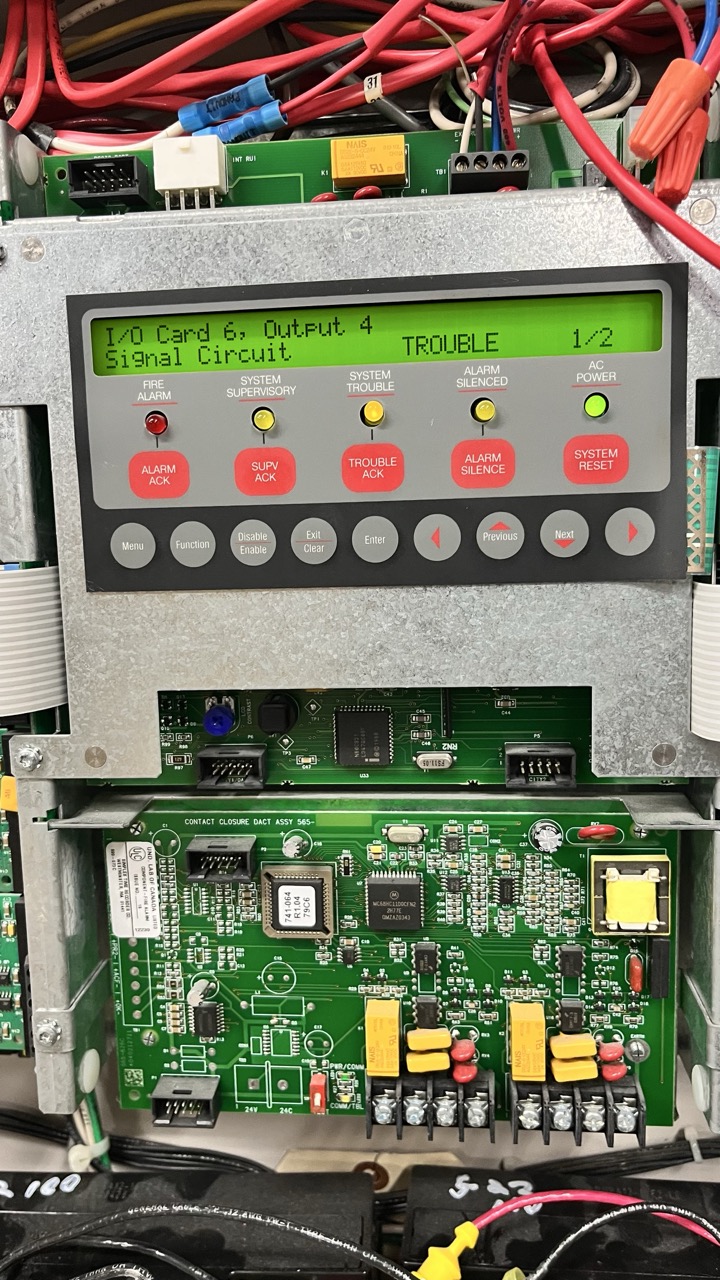
Fire alarm certified. We install fire alarm systems, smoke detectors, and carbon monoxide detectors for residential and commercial properties — ensuring your system meets all applicable code requirements.
What We Install
- Fire alarm systems (residential and commercial)
- Photoelectric smoke detectors
- Carbon monoxide (CO) detectors
- Combination smoke/CO units
- Interconnected hardwired systems
- Fire alarm inspection preparation
- Replacement of expired detectors
Ohio & Kentucky Code Requirements
Fire alarm and smoke detector requirements differ between Ohio and Kentucky, and between residential and commercial applications. We're licensed in both states and stay current on the codes.
Ohio Residential
- Smoke detectors required in every bedroom, outside each sleeping area, and on every level of the home including the basement.
- New construction and major renovations require hardwired, interconnected smoke detectors with battery backup. When one detector goes off, they all go off.
- CO detectors required in any dwelling with a fuel-burning appliance or an attached garage.
- Cincinnati and Hamilton County may enforce additional local requirements beyond the state minimum.
Kentucky Residential
- Similar placement requirements as Ohio - every bedroom, outside sleeping areas, every level.
- Kentucky adopted the 2018 International Residential Code, which requires interconnected, hardwired smoke alarms with battery backup in new construction.
- CO detectors required in dwellings with fuel-burning appliances or attached garages, per KRS 227.487.
Commercial (Both States)
- Commercial fire alarm systems fall under NFPA 72 (National Fire Alarm and Signaling Code) and the local fire code adopted by the authority having jurisdiction.
- System type and complexity depends on building occupancy classification, square footage, and number of stories.
- Most commercial spaces require a monitored fire alarm system that automatically notifies the fire department.
- Annual inspections and testing are required for commercial fire alarm systems.
Commercial vs Residential Systems
Residential and commercial fire alarm systems look different, work differently, and have different code requirements.
- Residential systems - typically hardwired, interconnected smoke and CO detectors with battery backup. Self-contained units that sound a local alarm. No central control panel required for single-family homes. Homeowner can test and replace batteries.
- Commercial systems - built around a fire alarm control panel (FACP) that monitors all devices in the building. Includes smoke detectors, heat detectors, pull stations, notification appliances (horns and strobes), and often connects to a monitoring service. System must be designed, installed, and inspected by a licensed fire alarm contractor.
- Monitoring - commercial systems typically require connection to a central monitoring station that dispatches the fire department automatically. Residential systems usually sound a local alarm only, though monitored residential systems are available.
- Inspection requirements - commercial systems require annual inspection and testing per NFPA 72. Residential systems don't have a formal inspection requirement, but testing your detectors monthly is strongly recommended.
NFPA 72 Basics
NFPA 72 is the national standard for fire alarm systems. If you're a property manager or business owner, here's what matters to you.
- Design and installation - NFPA 72 dictates detector spacing, notification appliance placement, wiring methods, and system configuration. Every commercial fire alarm system must be designed to meet these requirements for the specific building.
- Testing and inspection - commercial systems require inspection and testing at specific intervals: visual inspection (monthly/quarterly), functional testing (semi-annually/annually), and sensitivity testing (per manufacturer schedule, typically every 2-5 years).
- Documentation - every inspection must be documented on NFPA 72 inspection forms. These records must be maintained and available for the authority having jurisdiction.
- Impairments - if a fire alarm system is taken out of service for any reason (maintenance, construction, equipment failure), the building owner must notify the fire department and monitoring company and implement a fire watch if required.
Inspection Prep Checklist
Whether it's a fire department inspection, insurance inspection, or property sale, here's what we check and address to get your system ready.
- Test every smoke detector, CO detector, and heat detector for proper operation
- Verify all detectors are within their service life (smoke: 10 years, CO: 5-7 years)
- Confirm correct detector placement per code (distance from walls, ceilings, HVAC vents)
- Check interconnection - all detectors must sound when any one is triggered
- Verify battery backup on all hardwired units
- Test pull stations and notification appliances (commercial)
- Verify fire alarm control panel communication with monitoring station (commercial)
- Check emergency and exit lighting operation and battery backup
- Document all findings and provide a written report
If we find issues during prep, we fix them before inspection. We don't just identify problems and hand you a list.
Common Questions
We install photoelectric smoke detectors, which are required by many local codes including Cincinnati. We also install combination smoke/CO units where appropriate.
For new construction and major renovations, hardwired interconnected smoke detectors are required by code. For existing homes, requirements depend on scope of work.
Smoke detectors should be replaced every 10 years. CO detectors every 5-7 years. Check the manufacture date on the back of each unit.
Photoelectric detectors are better at detecting smoldering fires (more common in residential settings). Ionization detectors respond faster to flaming fires. Many jurisdictions now require photoelectric.
Yes, if your home has any fuel-burning appliances (gas furnace, water heater, stove) or an attached garage. Many local codes require them regardless.
Yes. We assess your current system, identify what needs to be updated or replaced, and bring everything up to code before inspection.
Safety Questions
Single chirps usually mean low battery. Continuous chirping may indicate the unit has expired and needs replacement. If multiple units chirp simultaneously, there may be a wiring issue.
Inside every bedroom, outside each sleeping area, on every level of the home including the basement. CO detectors should be on each level and near sleeping areas.
Don't disconnect it. Frequent false alarms usually mean the detector needs to be cleaned, relocated (away from kitchen/bathroom steam), or replaced. Call us to assess.